4Noise occurring during high-speed differential data communication
Issues When Performing HDMI Communication
Next, we will present issues that occur when performing HDMI communication in a home environment.
HDMI is widely used as a video system interface for connecting BD recorders, STBs, and TVs. It is also used as a stick PC interface for converting TVs into PCs. In the latest standard, HDMI version 2.1 was announced, but many users are probably using 2.0 or 1.4.
The table below shows the results when a stick PC was inserted into a TV and the Wi-Fi reception sensitivity was measured during HDMI communication. As shown in the table, the sensitivity is reduced by slightly less than 4 dB, and noise occurs in conjunction with HDMI circuit operation, which results in reduced reception sensitivity.
■ Wi-Fi reception sensitivity during HDMI communication
| |
Reception sensitivity(36CH) |
|
HDMI signal not available
|
-74dBm |
|
HDMI signal available
|
-70.4dBm |
|
|
3.6dBm Reduced |
Study of Signals During HDMI Communication
Then, what is happening during HDMI communication? We investigated the signal state.
 |
|
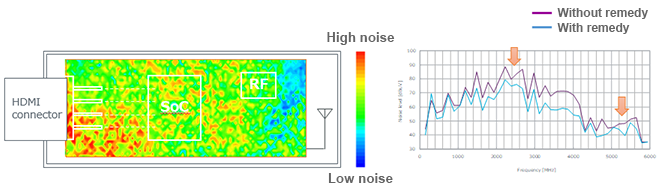
Stick PC structure and noise distribution
|
|
Improvement results using electromagnetic wave absorbing sheet
|
This shows a mapping of the magnetic field distribution for the PCB surface of the stick PC that was mentioned above. It consists of an HDMI connector, wireless circuit, and control IC, and because it is packed into a size of about 15 cm × 8 cm, all circuits are in close proximity to each other.
As a result, if noise occurs inside the device, it is coupled to the antenna and other RF circuits and easily disturbs wireless communication.
In this stick PC, because it appears that noise is distributed over the entire PCB, we affixed an electromagnetic wave absorbing sheet to the entire PCB and verified whether the level of noise coupled to the antenna had changed.
Doing so, the noise level dropped by about 10 dB, and this indicated that noise was coupled from the PCB to the antenna.
Possible Effective Remedies
As explained above, we affixed an electromagnetic wave absorbing sheet to the entire PCB and verified the improvement results, but when we consider that noise is generated when HDMI is running, we suspect that noise is being conducted in the signal line.
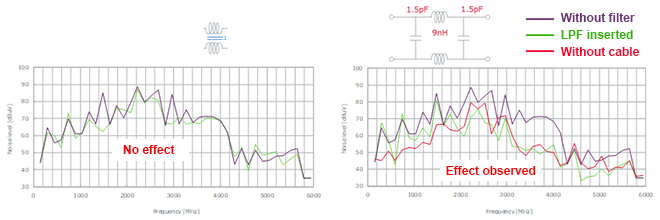
And so, we decided to try using noise reduction filters for the HDMI signal and clock lines. Two types of filters were used -- common mode choke coil and Pi low pass filter (LPF). A common mode choke coil is a filter that is effective for removing common mode noise only without effecting the signal waveform of the differential transmission line.
 |
|
Effect of common mode choke coil
|
|
Effect of LPF
|
Although no effect was observed using the common mode choke coil, the pi LPF was effective at reducing noise. In other words, this indicates that differential mode noise is being conducted in the stick PC that was being evaluated.
- ※The common mode noise component may be dominant for some target devices, and so a common mode choke coil may be effective in some cases.
Selection of Filter
Because we found that the differential mode noise was dominant, to reduce noise, we must select a filter that does not affect the signal.
At Murata, we have developed a new BLF03VK product series for providing effective noise reduction in the 5 GHz band. We selected an item with these characteristics from this product series.
■ Ferrite Beads for 5 GHz Band
【Features】Instead of the impedance increasing from low frequencies like conventional ferrite beads, the material and internal structure have been designed so that the impedance increases at 5 GHz.
This examines the filter for the 5 GHz band only, but our product lineup also includes filters for the 2.4 GHz band and 700 MHz band.
Effects of Remedies Using Noise Filters
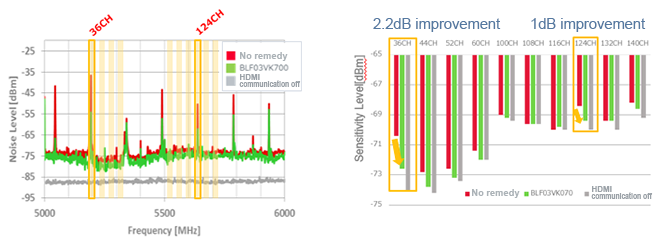
The figure below shows the results when the above-mentioned pi filter was replaced by the BLF03VK and the noise reduction effects were verified. It was verified that the high-frequency component of the clock was reduced by about 10 dB.
 |
|
Noise coupled to antenna
|
|
Wi-Fi reception sensitivity
|
The area filled in with yellow indicates the channels used by Wi-Fi (11ac), and noise can be seen in channels 36 and 124.
This resulted in a particularly large reduction in reception sensitivity in channels where noise occurred, but by applying a noise suppression using the new noise filter, the narrow-band noise originating from the HDMI clock was reduced for enabling higher reception sensitivity.
Check of Signal Quality
Because the filter was inserted in the HDMI data and clock lines, the signal quality was checked.
■ HDMI 1.4 Signal Waveform
The results for the HDMI 1.4 pre-compliance test that was conducted show that the test was passed without hitting the eye mask even when a filter was used.
This is partly due to the small impedance in the low-frequency band by the BLF03VK series, and the need is expected to grow for filters where the impedance increases only in the specific bands where noise will be removed for ensuring signal quality.
- ※ However, the waveform when the filter is actually used will vary depending on the IC and set environment, and so verification is necessary.